Low Level Laser Therapy
What is Low Level Laser?
Low level lasers - a truly amazing health tool - have been
used for over 30 years in many countries as therapeutic energy to bring about
favourable biological effects in both plants, animals and people.
Low level laser therapy has been proven completely safe in
over 2000 worldwide studies. There are two low level lasers available that have
been classified by Underwriters Laboratories as Class 1, Non-Significant Risk
Devices; and two have recently received FDA approval for the treatment of pain.
Low level laser therapy is being used as a successful
treatment option all over the world.
Low Level Laser Facts
Basic Laser Physics
The Physiology of Laser Energy
Veterinary Uses Of Low Level
Lasers
Medical Uses Of Low Level Lasers
Dental Uses Of Low Level Lasers
Basic Laser Physics
In order to clarify how low-level laser therapy affects the body, it is
necessary to review basic laser physics and developmental anatomy.
Laser means Light Amplification by Stimulated Emission of Radiation and
was first theorized by Einstein. In 1960 Miaman developed the first
laser, a ruby laser. This was a tube laser with a metal chamber, which
contained the element ruby. When an electrical current excites the
enclosed element, the atoms give off photons or packets of light energy.
The photons bounced off a solid mirror on one end of the tube and out
holes in the mirror on the other end of the tube. This light beam is
unlike regular light in that it is coherent i.e., the photons are well
ordered and synchronized. Laser light is also monochromatic, meaning it
is of one pure colour.
Power density is a key to laser energy. Power Density (PD), or light
concentration is measured in watts per centimetre squared (W/cm2). The
problem with most DC battery driven lasers is that the battery bleeds
off and does not maintain a standard PD, which negatively affects
low-level laser therapy (LLLT) results. Recent developments in miniature
computers have enabled the patenting of techniques that maintain a
standard PD as well as to control energy frequency.
Wavelengths are measured in nanometres. The most beneficial wavelengths
are in the visible and near infrared ranges. These ranges are very safe
ranges, far away from the damaging ultraviolet, x-rays, gamma and cosmic
rays. Although the longer waves such as microwaves and radio waves are
usually considered safe, there are some that think they might be
damaging to the very sensitive individual. All wavelengths used in
low-level lasers are safely divided from these potentially damaging
waves. Many people only think of lasers as cutting lasers. In order to
cut with lasers, it is necessary to increase the PD from 300 to 10,000
W/cm2. Lasers do not even have a warming affect unless they are operated
above 5 W/cm2. Low-level lasers discussed here operate from 1 to 3
milliWatts.
Low-level lasers today are manufactured using semi-conductors, which are
computer-like chips grown from various pure elements or combinations
thereof. Combining the elements of InGaAlP makes visible light in the
range of 630 to 685 nm; combining GaAlAs produces light in the range of
780 to 870 nm; and, combining GaAs produces infrared laser diodes in the
900nm range.
The visible light ranges, while quite beneficial, are limited by its
shallow penetration of 1 to 3 mm. The invisible or infrared light range
penetrates much deeper. Research documents infrared penetrations from 10
to 15 mm, but clinical results indicate that the infrared beam
penetrates 8 to 10 cm. Excellent results have been achieved using the
patented (Low Level Lasers, Inc.) concept of “piggy backing” the
beneficial effects of the visible upon the penetrating ability of the
invisible.
Low level lasers are used everywhere in our society, such as bar code
check out, laser printers, compact disc players and for many medical
procedures. In fact, without lasers, our society and economy as we see
it today would collapse.
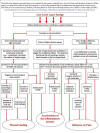
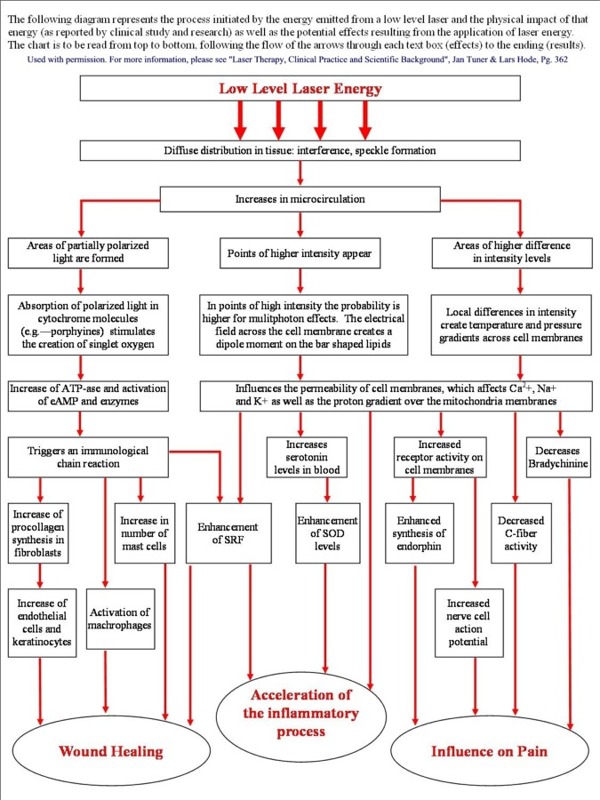
World-wide studies have shown that laser energy is accumulative as well
as cascading and reduces pain and inflammation via:
1. Bio-stimulation and photo-stimulation.
2. Endogenous opiate production
3. Slowing sensory nerve production.
4. Restoring cellular resonant energy.
5. Stimulating the Na/K pump mechanism in the cell membrane.
6. Inhibiting bradykinin & leukotriene production.
Osmosis, a scientific fact taught in all grade and high school science
classes, states that no nutrient can transfer across the depolarized
membrane of an injured cell. One of the most important functions of low
level laser therapy is to re-polarize sick and injured cellular
membranes. This allows for essential nutrients to transfer from the
blood into the cell. Research has shown that low level laser therapy can
increase cellular ATP (body fuel) by as much as 150%.
Back to Top
The Physiology of Laser
Energy
 Back to Top
Veterinary Use Of Low
Level Lasers
Low level laser therapy has been used in the US by veterinarians since
the mid 1980’s. These lasers are mostly higher power low level lasers.
These lasers range in power from 20 mW in the visible light range up to
900 or 1000 mW in the infrared range. Wavelengths vary, but the most
common are 650 or 660 nm in the visible spectrum and 808 to 830 in the
near infrared spectrum. Some of these lasers are a single laser diode
for acupuncture on animals or for the treatment of small areas, and
others are clusters of lasers and LED’s designed to treat larger areas.
Veterinary lasers are registered with the FDA and are legal to sell and
buy, but the company cannot make claims that they treat human disease or
disorders.
Back to Top
Low Level Laser Therapy In Medicine
NOTE! The following reviews of low level lasers is taken from
recently published international literature, much of which is available
utilizing any good web search engine and the search terms “low level
laser” or “low level laser therapy”. In most countries other than the
United States, low level lasers are legal to use on human subjects by
both medical practitioners and by the lay people themselves.
Low level laser therapy has been successfully utilized in medicine for:
-
Acupuncture
-
Acute myocardial infarction
-
Allergy
-
Blood irradiation
-
Bechterew’s disease
-
Blood pressure control
-
Bone regeneration
-
Cancer
-
Cardiac conditions
-
Prevents restenosis after balloon angioplasty
-
Decrease the number of angina attacks
-
Eczema
-
Alleviation of heart pain–cervicothoracic pain
syndrome
-
Suppression of lipid peroxidation
-
Promotion of antioxidants
-
Protection of erythrocyte membranes
-
Reduction of fibrinogen level
-
Normalization of antithrombin-III
-
Reduction of arrthythmic deaths (two year follow
up)
-
Reduction of the activities of the
hypophyseoaadrenocortical and aldosteron-renin-angiotensin systems
-
Protective effect on erythrocytes caused by
heart/lung machines
-
Carpal tunnel syndrome
-
Cerebral palsy
-
Crural ulcers
-
Depression, psychosomatic problems
-
Diabetes
-
Duodenal/gastric ulcers
-
Epicondylitis (tennis elbow)
-
Ear conditions including hearing loss and
tinnitus
-
Eye conditions
-
Fibrositis/fibromyalgia
-
Gynecological problems
-
Headaches including migraine
-
Hemorrhoids
-
Herniated lumbar discs
-
Herpes simplex (HSV1) of the lips as well as
sexual herpes
-
Immune system modulation
-
Lichen
-
Low back pain
-
Microcirculation
-
Mucositis connected with cancer treatment
-
Muscle regeneration
-
Nerve conduction
-
Ophthalmic problems – stye MUST use less than 5
J/cm2
-
Pain associated with any cause
-
Rheumatoid and osteoarthritis
-
Salivary gland disorders
-
Sinusitis
-
Spinal cord injuries
-
Sports injuries of all types
-
Strains and sprains of all types
-
Tendonitis/bursitis and other locations on man
and animals
-
Tinnitus (ringing in the ears)
-
Tonsillitis
-
Trigeminal neuralgia
-
Trigger point therapy
-
Thrombophlebitis
-
Tuberculosis
-
Urology problems including inflamed prostrate
-
Warts
-
Whiplash and associated disorders
-
Wound healing regardless of the cause
-
Zoster (shingles)
Back to Top
Low Level Laser Therapy Use
In Dentistry
There are 230 positive studies done by 81 universities from 37 different
countries showing from 80 to 95% success using LLLT on over 24 different
dental procedures.
-
Alveolitis (bone infection)
-
Anesthetic – used alone to replace or in
conjunction to enhance the depth or profoundness of dental
anesthetic
-
Aphthae ulcers (canker sores)
-
Bleeding – postoperative bleeding control
-
Caries – Used prior to drilling to PREVENT tooth
hyperemia and postoperative pain
-
Dentitio dificlis – pain around the coronal
tissue of either primary or permanent teeth
-
Endodontics – root canal – used to flush bacteria
out of dentinal tubules and reduce pain associated with root canal
-
Extraction – used before and after to control
bleeding, pain, and speed healing
-
Gingivitis (bleeding of the gums)
-
Herpes Zoster (cold sores)
-
Hypersensitive dentine - usually at gum line –
many over the counter tooth pastes are sold with less benefit than
LLLT
-
Implantology – reduces inflammation, speeds
healing, reduces inflammation, and increases bone growth
-
Jaw fractures
-
Leukplakia (precancerous tissue)
-
Lingua geografica
-
Lip wounds
-
Mucositis associated with cancer medications
-
Nausea – used prior to taking impressions to
prevent gagging
-
Nerve injury
-
Oedema (swelling)
-
Oral surgery
-
Orthodontics
-
Pain regardless of the cause
-
Pediatric dental treatment
-
Periodontics
-
Prosthetics – denture sores
-
Secondary dentin formation
-
TMJ/TMD (temporomandibular joint and associated
muscle disorders)
Back to Top
Content Copyright © 2007-2008 The
Intelligent Health Clinic.
Home | About us | Contact us | Prices | Reflexology | Scenar | Low Level Laser | Hot Stone | Nutrition
 Back to Top